HelioX: A GPU-Native Framework for Simulation and Training of Biophysically Detailed Networks
May 10, 2026·, ,,,,·
1 min read
,,,,·
1 min read
Junfeng Lu
Zijie Yu
Shaoyang Cui
Gan He
Ruiqin Xiong
Kai Du
Tiejun Huang
Abstract
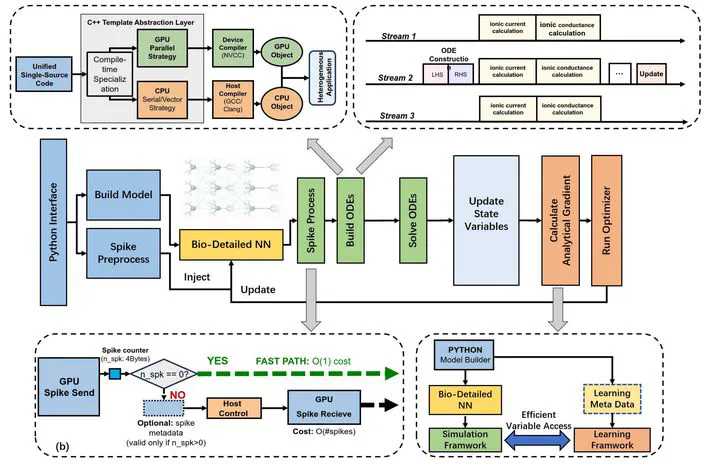
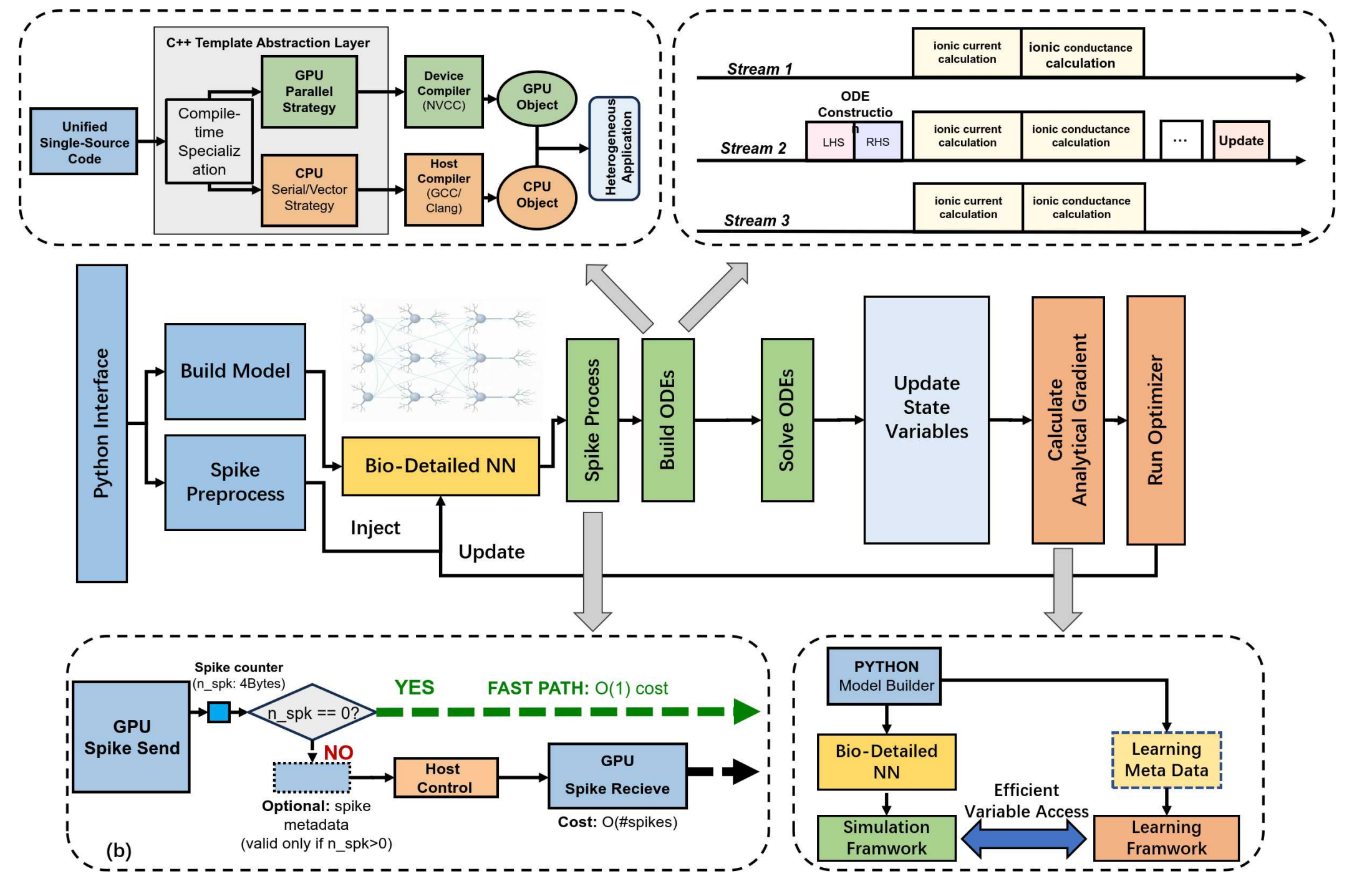
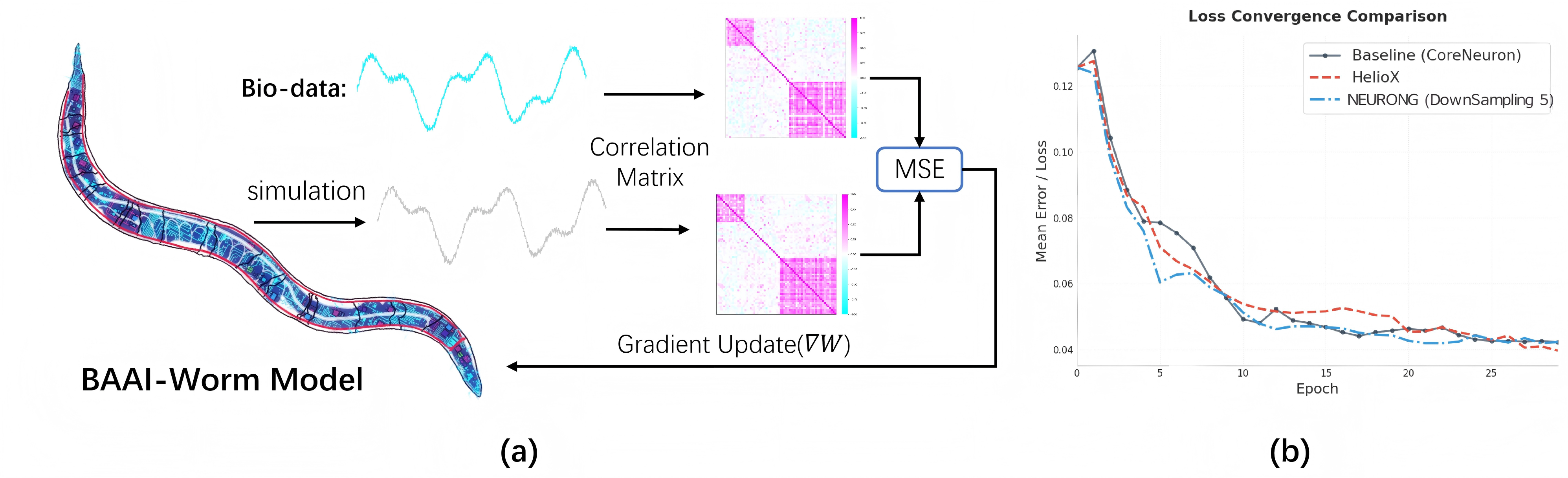
Biophysically detailed neural networks provide intrinsic spatio-temporal structure for brain-inspired AI, but their irregular dendritic topology is poorly matched to dense deep learning runtimes. HelioX is a GPU-native framework that unifies high-performance simulation and scalable training for biophysically detailed models via custom-fused CUDA kernels, analytical gradient propagation, and multi-stream concurrency. Across numerical and learning benchmarks, HelioX achieves strong speed and memory efficiency while preserving simulation fidelity, and enables deep biophysical MLP training and organism-scale C. elegans model fitting on consumer GPUs.
Type
Publication
International Conference on Machine Learning (ICML 2026)
Accepted at ICML 2026.
HelioX introduces a GPU-native path to train and simulate biophysically detailed neural networks at practical scale. Instead of forcing biological models into dense ANN-oriented execution paths, it aligns runtime design with dendritic structure and simulation dynamics.
Teaser
Key Contributions
- GPU-to-Biophysics Design: Custom-fused CUDA kernels for dendritic hierarchical scheduling and gradient propagation
- Unified Simulation + Training Runtime: End-to-end loop from simulation state updates to parameter optimization
- Efficiency at Scale: Significant improvements in throughput and memory usage across simulation and training workloads
- Large-Scale Feasibility: Demonstrated on deep biophysical MLPs and organism-scale C. elegans fitting tasks on consumer GPUs
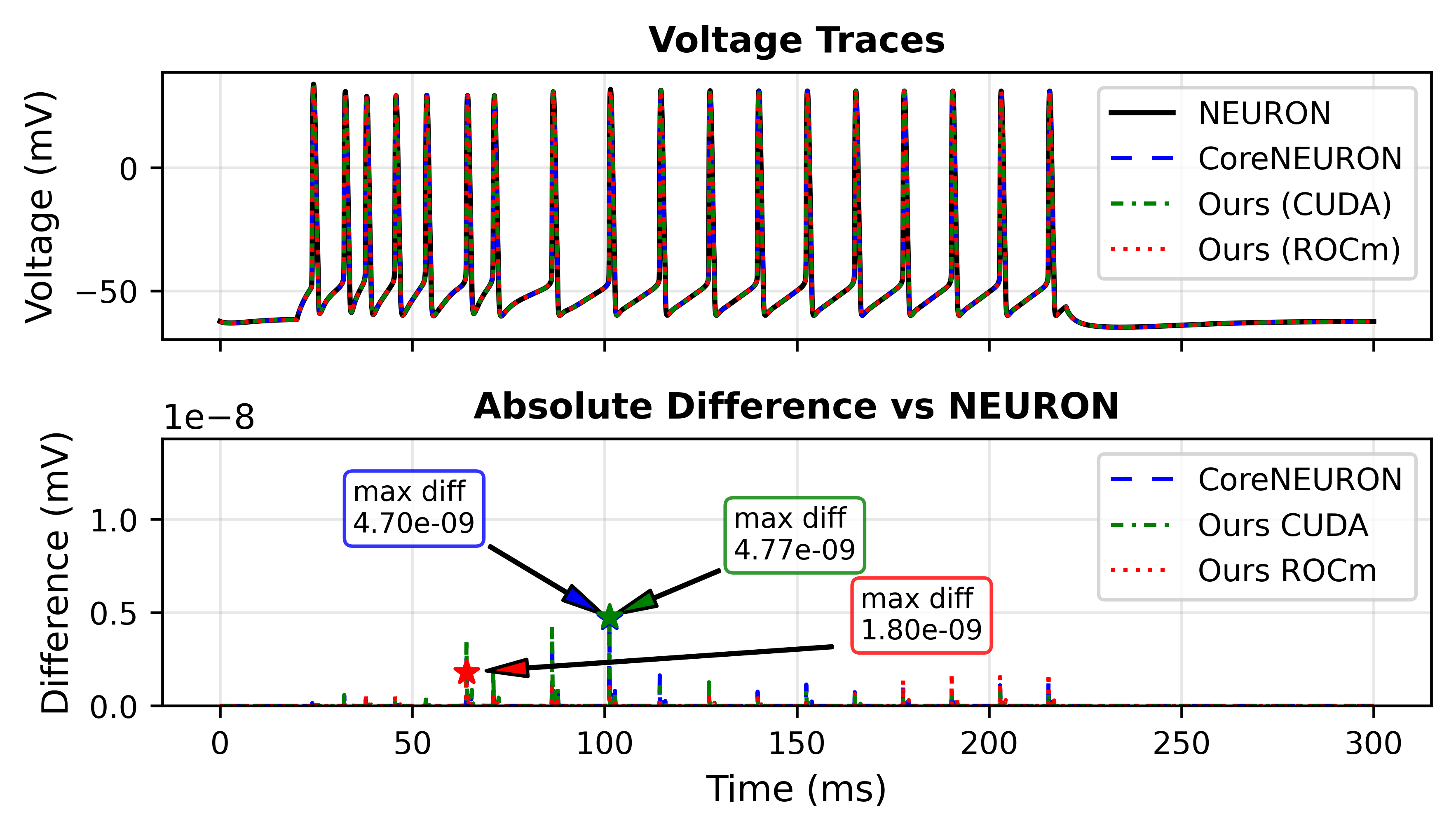
Numerical Fidelity and Throughput
Organism-Scale Training
Why It Matters
Biophysically detailed neurons carry rich temporal and spatial computation that point-neuron abstractions cannot directly capture. HelioX lowers the engineering and hardware barriers for using these models in trainable AI systems, making detailed-neuron research more practical for both computational neuroscience and brain-inspired learning.